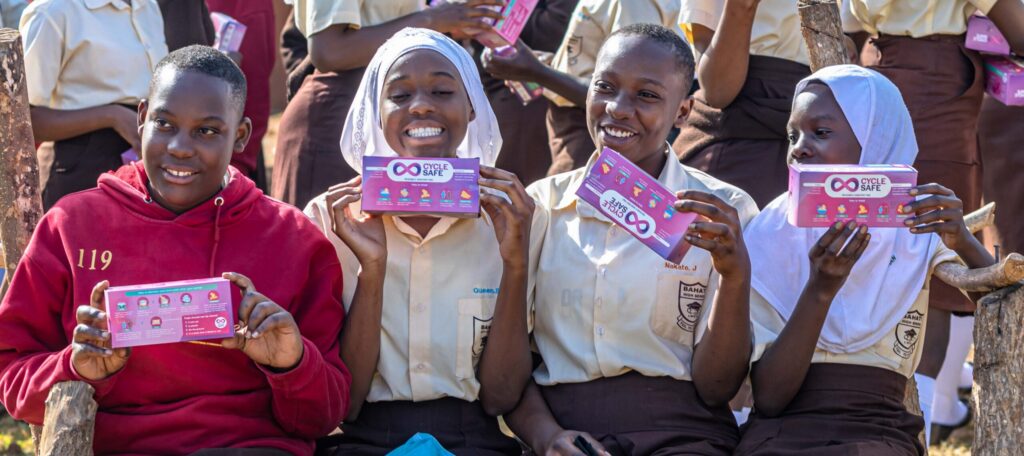
The CycleSafe Initiative brings together the Wakiso Vocational Training Hub and RedBox to create a single, self-sustaining cycle of empowerment, one where the skills women gain directly translate into the products and support that keep girls in school and communities healthy. Women trained at the Wakiso Hub go on to produce reusable CycleSafe sanitary kits, each lasting up to two years, which are then distributed through RedBox to more than 1,350 girls and women across Kenya, Uganda, and Tanzania, ensuring consistent, safe menstrual management without financial or environmental strain. Alongside distribution, our menstrual health and hygiene workshops reach over 1,000 community members, including girls, mothers, teachers, and community leaders, helping to break taboos, dispel myths, and open up honest conversations around menstrual and reproductive health that too often go unspoken.
The objective of the project is to reduce period-related barriers to education for girls in rural Uganda while creating sustainable income-generating opportunities for local women. The project aims to improve school attendance, menstrual health knowledge, and economic empowerment through a community-led model that combines reusable sanitary pad production, menstrual health education, and women’s employment. Our theory of change is that if girls have access to safe, reusable menstrual products, reliable water and sanitation facilities, and accurate menstrual health education, they will be better able to manage their periods, attend school consistently, and participate fully in their education. At the same time, if women who have completed our vocational tailoring programmes are provided with paid employment through local sanitary pad production, they will strengthen their financial independence and contribute directly to improving outcomes for girls within their communities.
The project therefore creates a sustainable cycle of empowerment: women who have completed tailoring training gain ongoing income through producing reusable sanitary kits, while girls receive the products and education they need to remain in school. By embedding production and delivery within the community through our local partner, NHDA, the project is designed to create sustainable long-term benefits beyond the grant period.
None of this would be possible without our partners on the ground. We work closely with Ishik Medical & Educational Foundation in Tanzania, Nile Humanitarian Development Agency in Uganda, and Omer Foundation in Kenya, whose local knowledge, community relationships, and operational support allow CycleSafe to be delivered safely, sustainably, and in a way that truly meets the needs of the women and girls we serve.